" width="3998.922119140625px"/></svg>)


How signal-based outbound tripled deal signings for a virtual-nursing platform

By Artyom Jurkevich, Founder & CEO, RevSculpt
The client came in with a clear goal: sell faster than trade shows allow. Their entire deal flow ran on in-person meetings at industry conferences. The company was signing 2-3 clients a quarter, and the founders saw no way to scale that, short of pouring a large budget into hiring a sales team.
We moved them off that model and onto signal-based outbound: pipeline that grows through a digital channel instead of offline meetings. Over six months, the signing pace tripled.
Results:
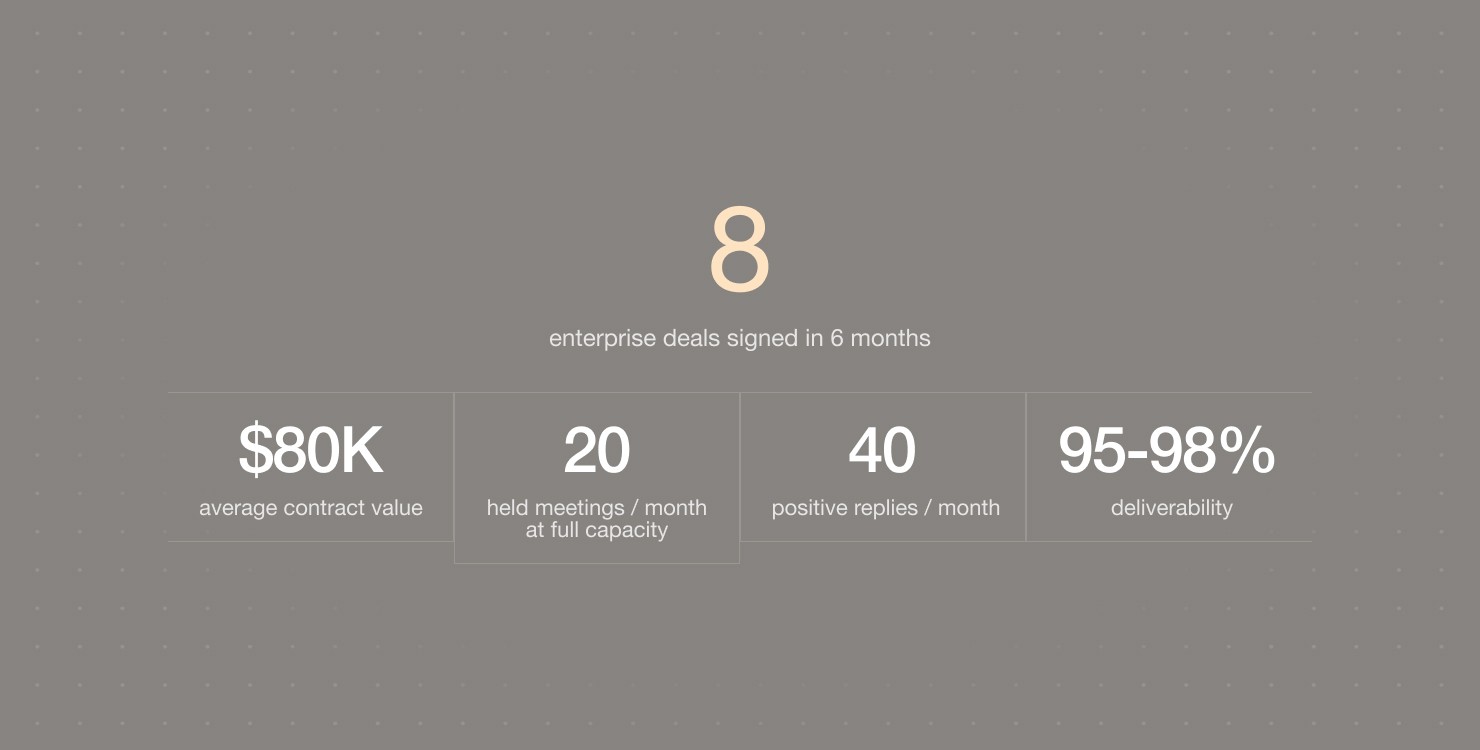
8 enterprise deals signed in 6 months, average contract value (ACV) ~$80K
Signing pace grew from 2-3 to 9-10 clients per quarter (3x)
~20 held meetings per month at full capacity
~40 positive replies per month on ~15,000 emails
95–98% deliverability throughout the engagement
Reporting in held meetings and SQL, enterprise-healthcare cycles are long, and the client owns the close
The product we were taking to market shows strong results in hospitals: 400+ deployments and 30 health systems, a 52% reduction in patient falls, and ~$7M in annual savings. These are the numbers the client leans on in every conversation with a new hospital.
Why a sales process built on in-person meetings always hits a ceiling
The model worked, but it didn't scale. The team flew to conferences, met people in person, and walked deals through by hand. A process like that always hits the same ceiling: its capacity equals the number of hands and the number of events in a year. Between conferences, deal flow simply stops, and the only way to grow it is to hire more people.
When we unpacked the situation, three things were holding that ceiling in place.
There was no way to find the “hot” hospitals among thousands of similar ones. There are a lot of hospitals in the US, but a virtual-nursing platform isn't needed by all of them at once, only by the ones where nurse turnover is acute right now. Without that filter, outbound turns into spray-and-pray, and in a narrow enterprise niche that burns through both the list and your domain reputation fast.
The decision wasn't made by one person, we had to thread three. Rolling out a system like this touches the Chief Nursing Officer (nurse workload), the CIO (integration and security), and the CFO (budget and ROI). A message written for one of them stalled with the others.
The message talked about the product, not the hospital's situation. Strong product numbers only work when they're tied to a specific hospital's pain. Out of context, it's just another vendor pitch, the kind a CNO closes in under a second.
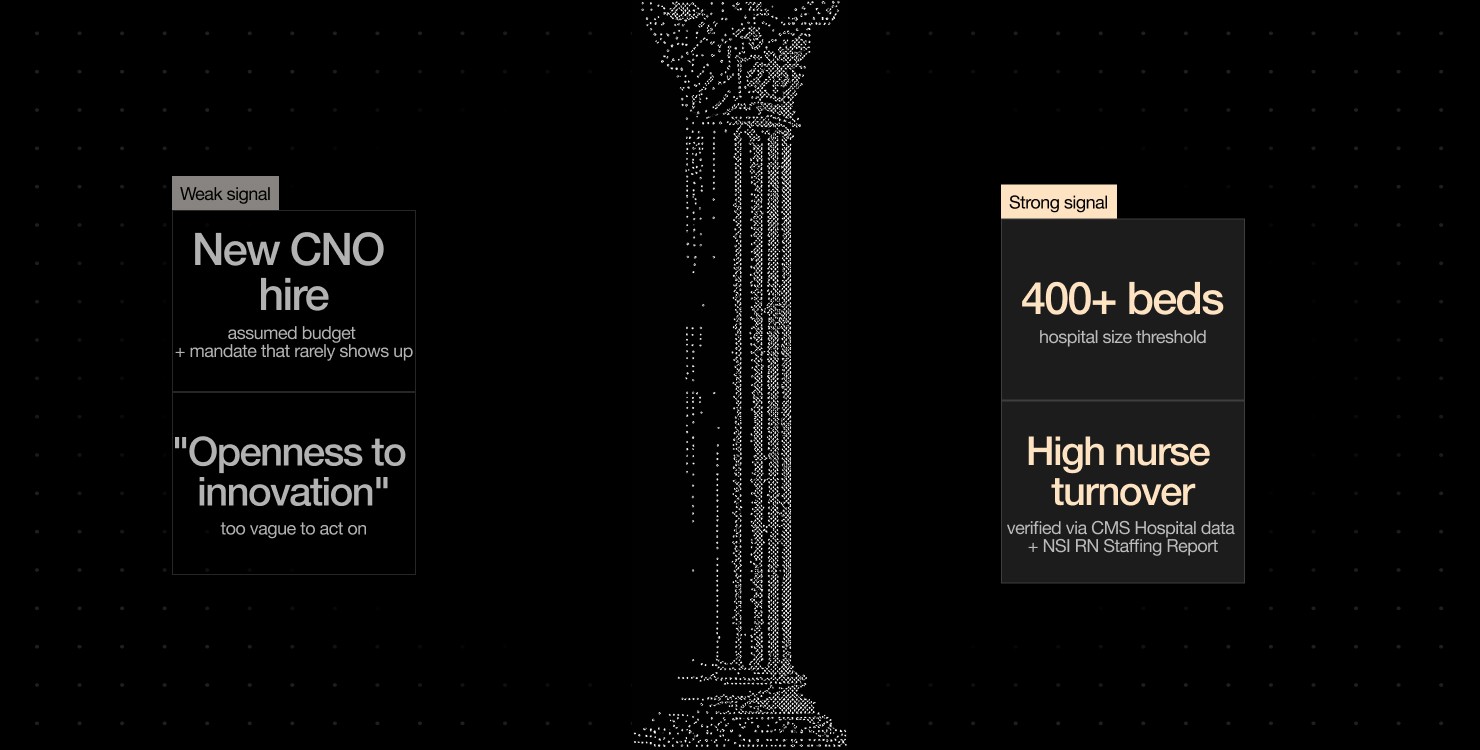
The signal is a hospital that needs relief now: 400+ beds and high nurse turnover
We don't build campaigns around contact lists. We watch what's happening inside a target account and reach out only when there's a reason.
The starting point was public data. The US maintains an open registry of hospitals, CMS Provider of Services / Hospital General Information with bed counts and facility characteristics. We cross-checked nurse turnover and staffing shortages against industry data: the NSI National Health Care Retention & RN Staffing Report documents double-digit annual RN turnover nationwide. On that base, we built a profile of the hospital that genuinely needs this platform now:
400+ beds. Large health systems where nurse workload and the cost of turnover are measured in millions, not in incidents.
High nurse turnover and staffing shortages. From public reports and news: a hospital that constantly hires and loses nurses is a hospital that needs relief right now.
Small hospitals don't buy, and “new hire” signals are a myth
We revised two hypotheses mid-engagement, and they're worth stating plainly.
We started with small hospitals, they have neither the budget nor acute enough pain. The first bet was on smaller facilities: there are more of them and they're easier to reach. But while turnover exists there, the cost of the problem doesn't justify the cost of the rollout, the math doesn't close. We worked it out, including conversations with the client's marketing team, and shifted targeting to 400+ beds.
The “new CNO hire” signal doesn't work and we build on hard data. It was tempting to target on a new executive hire or on “openness to innovation”: the assumption is that a new person arrives with a budget and a mandate to change things. In practice, that's the weakest signal, a hire almost never means readiness to buy now, and that lesson cost us real money. So we stopped relying on “they hired someone new” and built targeting on verifiable data: bed count and nurse turnover. A weak signal is worse than no signal, because it creates the illusion of progress.
How we found the right person: a custom web-search agent
Public data gives you the hospital. After that you need a specific person with a working contact, and no ready-made list of those exists anywhere. We closed that gap with a custom agent that ran through these steps:
Takes the hospital name and finds its Google Business Profile.
From there reaches the facility's official website.
Does a three-level “deep” crawl of the site down to the team section.
Selects the person who best fits our ICP.
Pulls the name and email directly, since executives are often visible somewhere, or recovers the contact through waterfall enrichment across seven providers in a row until a valid address is found.
On top of that ran an enrichment layer from public reports: bed count, turnover figures, recent hospital events, everything that later became the first line of the email. This is the part that separates a personal email from a blast.
Messaging for the CNO: one pain, one number, one question
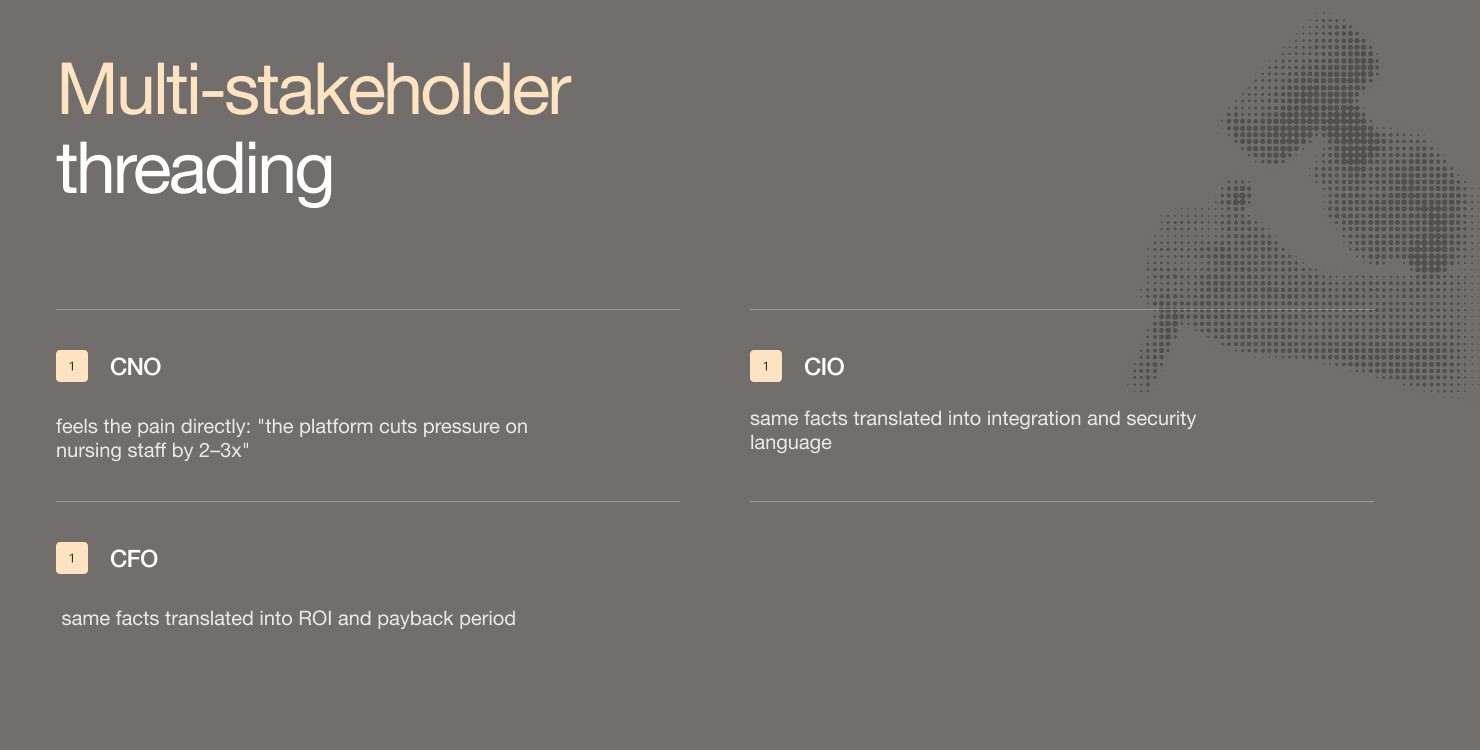
The message was short and tied to money. The logic: we see that your nurse workload and turnover are above the norm; by our formula that costs the hospital roughly $X a year; the virtual-nursing platform cuts pressure on nursing staff by 2–3x. One specific reason, one number, one question at the end.
For the CIO and CFO, the same facts were translated into different languages: integration and security for the CIO, ROI and payback period for the CFO. That's multi-stakeholder threading: not one email to “everyone,” but a coordinated conversation with three roles, each seeing its part of the picture.
Channel partners are a distinct sales channel in healthcare
In the US medical market, consultants and advisors play a major role. Physicians and administrators rarely decide alone, and a trusted intermediary is often part of the process. So alongside direct outbound we plugged in a partner layer: reaching the people already trusted inside these hospitals. In this vertical, channel partners are a full channel that accelerates trust.
Six months: from infrastructure to 9–10 deals a quarter
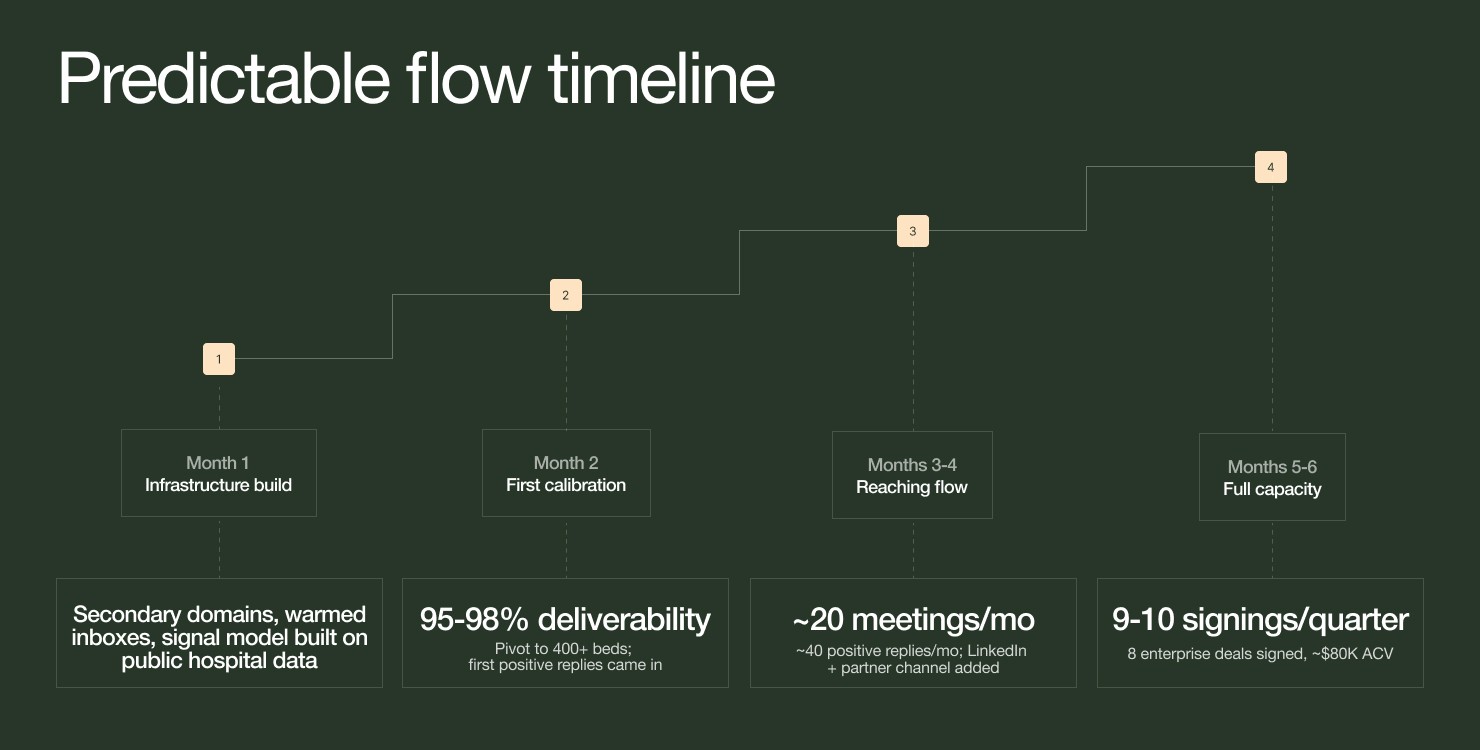
Months 1-2: infrastructure and first calibration. We stood up dedicated sending infrastructure: secondary domains, warmed inboxes, deliverability monitoring, and built the signal model on the public hospital database. This is also where the first pivot happened from small hospitals to 400+ beds. By the end of the period deliverability held at 95-98%, and the first positive replies came in.
Months 3-4: reaching flow. We connected LinkedIn ahead of the email, giving prospects a familiar face before the email lands in the inbox, and added the partner channel. We stabilized at ~40 positive replies and ~20 held meetings per month. The first deals from early meetings entered a long approval cycle.
Months 5-6: full capacity. The system reached a run-rate of 9-10 signings per quarter versus the prior 2-3. By this point the niche's limit was visible too: there's a finite number of quality 400+ bed hospitals, and we'd begun working through the segment.
Results: 3x the signing pace in six months
Over six months, outbound went from manual and conference-bound to a predictable flow of meetings with the right people.
Metric | Result |
|---|---|
Enterprise deals signed in 6 months | 8 |
Average contract value (ACV) | ~$80K |
Signing pace per quarter | increased from 2–3 to 9–10 (3x) |
Held meetings per month at full capacity | ~20 |
Positive replies per month | ~40 |
Deliverability | 95–98% |
We deliberately report in held meetings and SQL rather than closed deals. The deal cycle in enterprise healthcare is long, individual deals stretched to three months, and the close sits on the client's side. Our zone of responsibility is to bring a qualified, ready-to-buy person to the conversation. What closed is the result of our pipeline working together with their sales.
“We used to know exactly one way to sell, fly to a conference and shake hands. It worked, but the ceiling was obvious: between events, everything went quiet. RevSculpt gave us something we never had, a flow of meetings that doesn't depend on the event calendar. And more importantly, the right people were in those meetings: not the merely curious, but the ones whose pain was acute right now.”
— Morgan Lane, VP of Sales
Key lessons: enterprise outbound in healthcare/MedTech
The signal decides, but which signal matters. Nurse turnover and bed count are strong signals because they're tied to money. “They hired a new CNO” and “openness to innovation” are weak, because they're tied to nothing. The difference isn't theoretical: a weak signal creates activity without deals, and it costs real budget.
In a narrow niche, the TAM is finite, build that into the strategy. There's a limited number of quality 400+ bed hospitals. A good signal model reaches the segment ceiling fast, and an honest conversation about that up front beats a promise of endless growth.
The decision isn't made by one person. The CNO feels the pain, but the budget sits with the CFO and the integration is signed off by the CIO. Multi-stakeholder threading isn't “more emails”, it's a coordinated conversation with three roles at once.
Channel partners in healthcare are a distinct channel. The market runs through trusted intermediaries. Ignore them and you lose the fastest path to trust.
Specific numbers sell harder than general promises. A 52% fall reduction and $7M in savings work when they're tied to a specific hospital's situation. The same figure out of context is just a vendor slide.
When this approach doesn't apply
Signal-based outbound is a precision instrument, not a universal one. It delivers under specific conditions.
The product has no proven results. Here, strong product numbers did the work. Without them, the signal model can bring the right people in, but the offer is too weak to convert. Meetings happen, but deals do not.
The niche is too narrow and exhausts quickly. If there are very few quality accounts in the segment, outbound works through them in a couple of months. Then you need a segment-expansion strategy, not just execution.
ACV below the threshold. The infrastructure of signal-based outbound pays off at deal sizes where the math works. At a low average contract value, it doesn't.
One person decides, with no approvals. If the purchase is simple and fast, multi-stakeholder threading is overkill, a lighter model is enough.
FAQ
How do you reach CNOs and CIOs at large hospitals through cold outbound? Through signals and specificity, not volume. In this project we targeted health systems of 400+ beds with high nurse turnover, found the right person with a custom web-search agent, and opened the email with a reference to that hospital's specific situation. CNOs and CIOs are busy people; the chance of a reply comes not from persistence but from proof that you understand their situation.
Which buying-intent signals work in healthcare and MedTech? The best are tied to money and verifiable from data: high nursing turnover and large bed count. Popular signals like a new executive hire or “openness to innovation” are weak in practice, they create activity, not deals. A hire almost never means readiness to buy now.
How long until the first meetings appear? In this project, the first positive replies came in the first two months, once infrastructure was stood up and the signal model was calibrated. The system reached full capacity (~20 meetings a month) by month 3-4. Across our projects, the average time to first meeting is around 18 days.
Why do you report in SQL and held meetings rather than closed deals? Because the close sits with the client. The enterprise-healthcare deal cycle is long, individual deals ran three months, and the final “yes” depends on how the client works its qualified leads. Our responsibility is to bring a ready-to-buy decision-maker to the conversation. Held meetings and SQL reflect that zone honestly.
What is pain-qualified outreach and how is it different from a regular blast? It's outreach that goes out only when an account shows a specific “pain” signal, with the message built around that pain. The difference from list-based blasting is that you write not to “everyone who matches the filter” but to those whose problem is acute right now, and you speak to exactly that.
Ready for predictable pipeline?
Book a 30-minute strategy call. We'll review your current outbound, find what's missing, and show what a signal-based system could deliver for your market.

Spots are now available
Ready for consistent pipeline?
Book a 30-min GTM audit. We'll review your outbound, spot what's missing, and show you what a signal-based system could deliver for your market.